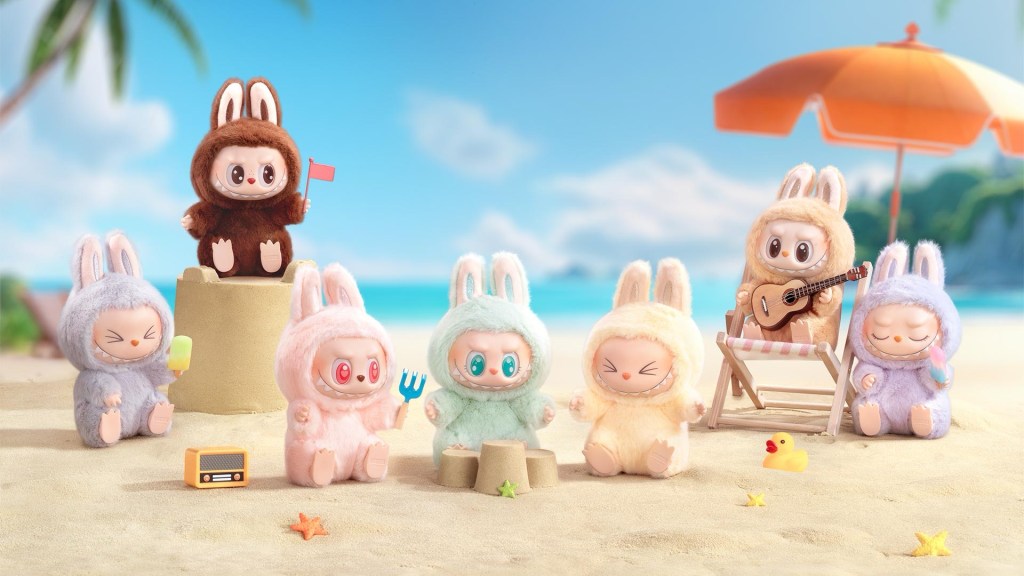
I immersed myself in TikTok live selling to see what it’s like to hunt for Labubus. What I found was predictably insane in some ways—but also very interesting
One of my favorite things about humans is that we never cease to discover new ways to find and create communities, even around the most ridiculous things. While culture critics rant and rave about how isolated we’ve become—and I agree we have, in many ways—people still jump at the chance to feel connected to movements and group identities whenever they can.
Social media has lowered barriers for finding belonging, so there are an endless number of communities around hobbies, fandoms, identities, politics, sports, and increasingly, consumption. These things of course always existed, both offline and in earlier versions of Internet culture, but it happens and changes at lightning speed now. Outdoor enthusiast? Sneaker head? Stationery nerd? Zero waste activist? There’s a community for that. Humans bond over loving the same thing and hating the same thing. We bond over being born in the same zodiac. We join Facebook groups to bond with people who share our names.
Recently, I immersed myself in the high-stimulation world of TikTok live selling and Labubu hunting to experience how this trend that originated in East Asia is unfolding in the U.S. Labubus are so popular that people are having Labubu meetups and doing impromptu Labubu fashion shows in the park. A tattoo artist at that event was giving people’s Labubus face tattoos. There’s an entire industry of crafters on Etsy who make handmade clothing for Labubus. I love to see that kind of joy and creativity. As a person who doesn’t really get that academically philosophical about consumerism and capitalism, I feel I went in with a pretty open mind. And to be honest I found it fascinating.
My examination of the Labubu craze is specific to the thousands of people in the U.S. who go Labubu hunting on TikTok, which is a small segment of the broader audience that lines up outside of Popmart or buys them from scalpers on platforms like StockX or eBay. It’s all interesting, but I think the camping out and scalping has been par for the course across all highly desired products for a long time so I’m not as fascinated by that. (The fights, however, are pretty extreme.)
On TikTok, I’ve been surprised to see that Popmart has figured out how to get some Americans into live selling, which as far as I know originated on Chinese social media. I used to work in China and witnessed the rise of a huge generation of consumers. In its most extreme form, live selling involves a host who flashes some crazy number of products on the screen and describes the products in a motor-mouth fashion, creating an anxiety-inducing sense of urgency and making people want to buy buy buy. If you’ve ever been to a crowded market in China you sort of wouldn’t be that surprised that the online manifestation of hard selling would look like that. It’s so different from the way people like shopping in the U.S.
In the west, people have covered and talked about the crazy live sellers in China, from the perspective of “look at this foreign culture on the other side of the world.” Amazon has made some feeble attempts to create sales content through influencer programs, video reviews, and live selling but the latter feels out of place. Like stop trying to make this a thing, it’s not a thing.

Enter Labubu – the backdrop
Labubus were originally characters from an illustrated book series called The Monsters by Kaising Lung, who was born in Hong Kong and grew up in the Netherlands. The series is 10 years old.
Lung began working with Chinese toy company Pop Mart in 2019, which makes figuring, plushies, and accessories. They rose in fame as celebrities began hanging the plushies on their bags, and truly popped when Lisa from the K-pop group BLACKPINK was spotted with one.
Pop Mart, being a company that is boss-level good at capitalizing on people’s most base physiological desire to collect and to seek exclusivity, has successfully turned that momentum in popularity and combined it with a sense of scarcity to stoke a global frenzy for the toys.
The foundation of its (some may say predatory) business model are blind boxes, which turns consumption into a “game.” The game is simple: Pop Mart releases toys as series with many different versions on a theme, that you can buy either as individual boxes or as a complete set. You’re either hunting for your “targets” in the product line, or you’re hunting for a “secret” additional version which has higher “value” because it’s more scarce. The secret may be mixed in with a full box set, or replacing one of the regular ones, or you’ll get it randomly in the individual box.
You “play” by buying individual boxes until you get either your target or the secret, and risk buying duplicates, or by buying whole sets which guarantee no duplicates. I’ve heard stories of people spending almost $2,000 buying and rebuying the same set over and over in search of a “secret.”
To be sure, buying surprise products in Asian culture isn’t new by any stretch. I don’t know the full history but as an example when I was a kid it was common in Japan to purchase gift bags without knowing what was inside; but as far as I know this was more of a way to get rid of overstock than it was to trick people into spending more money. Pop Mart’s sales tactic on the other hand is maniacally brilliant not only because it makes people buy more than they want/need, but also because it completely eliminates the company’s need to predict the demand and strategic inventory placement for different color variations in each product line. (Note: I used to cover supply chain as a reporter so I’m a nerd for this stuff)
So that sets the scene. Everyone wants a Labubu, which on an individual basis are not that expensive ($20-30), but the only way to get one is to jump through crazy hoops to be on time for a drop, pay many multiples of the retail price to a scalper, or get into TikTok live selling. My armchair diagnosis is that most people who are into Labubus are into the thrill of the hunt just as much, if not more, than the toy itself. And all of these methods create that thrill. It makes every Labubu feel hard earned, even if the price tag doesn’t faze you.
What live selling is like
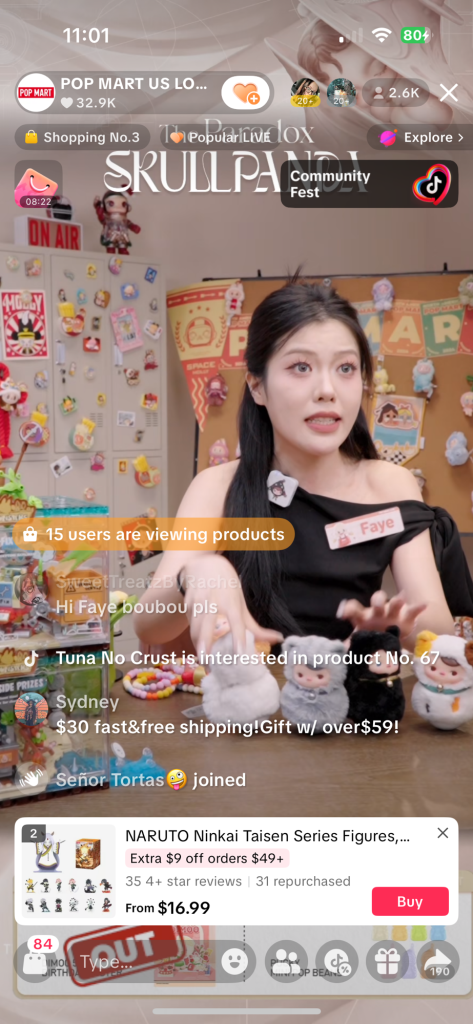
To fully understand this phenomenon (I’m just fascinated by this stuff, what can I say), I spent several hours watching and observing Pop Mart’s live streams on TikTok, and even made a couple of purchases to see what the experience was like.
As far as I can tell, the company has something like six U.S. facing live channels on TikTok that stream for many hours every single day. There’s a Spanish language channel where the host I saw is Latina, and an unboxing channel that is only streaming in the day time where the host is Black. Four are English language streams run by ethnic Chinese staff whom I guess are from mainland China based on their accents, and I think 1-2 of those four might be based in the U.S., where Pop Mart has a California warehouse. Labubu hunters on Reddit say the four Chinese live streams run for about 12 hours a day. I note everyone’s apparent backgrounds because most of this post surrounds cultural crossover and exchange.
There are two separate styles of live selling and I’m going to explain them separately. One type is best described to millennial and older folks as infomercials/QVC/HSN on crack. Not steroids, but crack.
Whereas once upon a time you might fall asleep with the TV on and wake up to some guy trying to sell you a vacuum that doubles as a humidifier or a microwave that will bake you a cake for 45 minutes straight, Pop Mart has cute young hosts talking a mile a minute to get you to buy a random trinket you don’t need for 45 seconds at a time.
The hosts work several hour shifts before switching off and are bubbly the ENTIRE time. They talk about every product like it’s the most amazing thing Pop Mart has ever released, and like every minute might be the last minute you can ever purchase it. This is of course total BS and you know it, but you still kind of want to believe them and no one faults them or calls them out for it.
They’re well trained to take customer complaints and mean comments in the chat without pause, but to be honest those are rare. They know the name of every SKU Pop Mart has ever released and rattle them off in shorthand like a secret language. They either remember their regulars or shout people out as if they do, making anyone watching feel like they’ve wandered into a manic, pastel kawaii version the neighborhood bar where everybody will know your name if you become a regular, too.
Each live stream is set up with multiple camera angles so the host can easily switch between wide and close shots, and walk around their desk for a full body shot when showing off larger items. They sell all of Pop Mart’s toys, not just Labubu’s, but Labubu’s are always strategically placed in the foreground or background because they know people will watch for a little while just to see if they’re talking about the coveted monsters. Ninety-five or more percent of the time, they aren’t. The live streams showcase as many as 90+ product lines at once that people can peruse at any point, regardless of which the host is talking about at any moment.
Part of what keeps a lot of people watching for longer is that the hosts will suddenly announce surprise drops. I’m not sure if the “surprise” drops are different than what they call “silent” drops—watching these live streams several nights in a row don’t demystify that for me—but the hosts claim they have no idea that these drops will happen and are notified at the same time as the audience is. So you could be watching a host talk lovingly about a little figurine one second and all of a sudden she’s frantically ringing a bell and yelping because a limited number of Labubus are suddenly available.
The moments come and go in the blink of an eye—no surprise Labubu drop I’ve witnessed has remained available for longer than a few seconds. Savvy TikTok shoppers seem to have identified the days and times when Pop Mart is most likely to make a surprise drop, though they tease new product releases in advance and supposedly launch most brand new things on Thursdays.
And oh… that bell. I haven’t fully formed my thoughts on their constant use of countdowns from 5 and running bells, which are definitely some sort of Pavlovian tactic to make people want to spend money even if they don’t really want the thing. They ring the bell when drops happen, but they also count down and ring it again when there are “flow backs” on hot items, a.k.a. resetting inventory numbers by cancelling incomplete orders. It trains people not to hesitate and to buy first and assess later.
The hosts also give the impression of transparency, as a tactic to make people feel in the know. They make references to their different warehouses, frequently speak to their “boss” off camera, and refer to Pop Mart’s intellectual property as “IPs,” which is business jargon most average consumers would not have used in the past, but increasingly do because of the growing popularity of obsession-level consumption that makes people feel even more connected to retailers by having more knowledge of their supply chains and business models, not to mention shipping times to know how long their gratification will be delayed. These are subtle but clever ways to make the hosts more relatable, like there’s a system standing in between every customer and a Labubu and they’re the on the customer’s side, leading the pack through the system to get to what it wants.
The gamification of unboxing
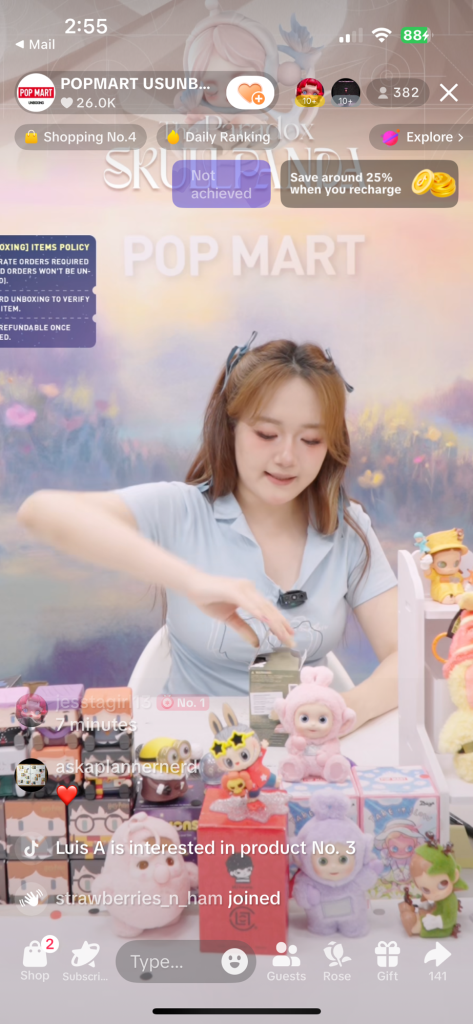
The other style of live selling Pop Mart uses is unboxing. This style of sales is one the world was primed for, what with the renewed craze for Pokemon cards, YouTube unboxing content, influencers doing hauls, and other kinds of surprise toys that have long been around. Some people just really freaking love watching other people buy stuff.
So on Pop Mart’s unboxing channels, people can purchase two blind boxes at a time, or the whole set. Their orders are printed on slips and the host opens the outer boxes live on camera, but not the inner bag, so they can see the product card and announce to the buyer (and hundreds of onlookers) what they got. The fun hosts will pause and ask what the buyer’s targets are and hype the chat up to root for them to get what they want. If anyone gets the “secret” version, every host has their own preferred celebration. One uses party poppers, another waves around a banner. They all ring the bell and congratulate the buyer, and they have a counter on the desk showing how many secrets they “pulled” that day. It’s kind of nuts, but for someone like me probably more exciting than opening a secret by myself at home.
I don’t know how these hosts don’t get musculoskeletal injuries and paper cuts. They repeatedly open boxes at a breakneck rate for HOURS, all while keeping up with annoying people in the chat whining about various things, staying upbeat, and talking nonstop. Every half hour or so they will pause to pick up a giant water bottle and gulp loudly into their mics, before gasping for air and then continuing their unboxing frenzy. The customers cheer them on and give them encouragement, telling them they’re doing great and occasionally asking them to autograph the boxes.
Some hosts are notably slower than others. I noticed the men seem to be universally slower than the women but one guy, Woody, is a fan favorite. I only saw him on one stream and he was pretty hilarious, he was wearing some kind of costume and was interacting with the audience a lot. At one point he threw out the question, “is it really true that in America you can change your name to anything you want?” And when the viewers said yes, he started giving a random Pop Mart character name to every single person whose order he unboxed, frequently cracking himself up. I’ll admit, that stream was pretty fun to watch.
Another fun one was when some guy ordered a surprise Labubu drop and kept spamming the chat asking the host to open the box from the bottom. His order took a long time to come up and she was barely keeping up with the pace, so people grew tired of his begging and pleading. They decided he must be a scalper, based on how desperate he was to keep the box in tact, so they started piling on and making fun of him. They campaigned for the host to rip his box to shreds and throw it out. Hilariously, when it was his turn, she treated his order like everyone else’s and opened it from the top and moved on. The chat rejoiced, but he wasn’t there. When he returned and asked what happened, people teased him mercilessly about his boxes. I don’t actually know if he was a scalper. He was extremely annoying, but he was also bullied. This might make me a bad person, but as an onlooker I was entertained.
Connection and cultural exchange

I know many people out there will read this and think this all sounds like the ninth circle of hell. I’d be lying if I said I don’t partially think that way too.
But I also saw something intriguing, watching the Chinese hosts interact with buyers from another country with a different culture, and watching how the common desire for a product could make people participate in something that would seem weird in other contexts.
For the most part, people in the chat appeared to be non-Chinese Americans; and being American-born Chinese myself, my experience is that many non-Chinese Americans, especially outside of major cities, would rarely if ever have the opportunity to befriend or spend significant time with a first generation Chinese American person much less a Chinese person in China (because most American and Chinese people do not travel internationally—we have that in common). There is even historically a lot of hostility in the U.S. about China and Chinese products, but none of that comes through in these live stream chats, except for the occasional person who claims they can’t understand the host (other people in the chat are quick to shush those people).
The Chinese hosts are clearly not native English speakers but are very comfortable speaking English and also make cultural references that suggest their study of the language is more than about just the language. One host said it was her last day because she was moving to London to get her Masters Degree in communications. Some of them have some decent use of tone and regional accents which is impressive, though almost all of them do the thing (that is common in China among English-speaking Chinese people) where they refer to everyone with a pet name, like “baby” or “hunnie” in every single sentence. The fact that English isn’t their first language helps them get a pass when they mispronounce everyone’s name and username.
Cultural exchange on the internet is of course nothing new. But part of the reason this exchange feels so unique to me is because of how insular the Chinese internet is relative to other countries. The government engages in censorship both as a form of political control and as a way to protect Chinese Internet companies from competition (this very simplistic statement is based on years of reporting I did on Chinese Internet censorship and surveillance). International travelers in both countries of course exist in abundance, but are still a minority of each place. As a result of this and also the very basic issue of language barriers, there aren’t as many touch points between American and Chinese general Internet users as there are between Americans and other countries. E-commerce is, as it turns out, the safest subject around which people in the two countries can communicate, and hyper consumption something both China and the U.S. have in common.
Lastly, it’s notable that China is a country more often associated with IP infringement and not IP ownership, so American consumers freaking out over getting to buy an authentic Chinese IP that is OVERTLY Chinese is a pretty unique phenomenon in and of itself. Other examples, like the Chinese consumer drone and camera company DJI and of course TikTok itself (via acquisition) are also beloved Chinese brands but they don’t flaunt their Chinese roots in quite the same way as Pop Mart. Xiaomi is another example of a Chinese consumer brand with success out of China, but nowhere near as coveted by as many people as these fluffy Labubus.
It all makes me wonder if the Labubu craze adds to Chinese soft power, or if it’s purely just the latest example of the latest evolution of consumption? Maybe both.
So did I cop any Labubus or what?
I did, more out of curiosity and participation than anything. I have actually long had a collection of cute toy-like bag charms I’ve hung on my bags since well before Pop Mart existed (I’m on my 40s, so decades). I love a good fluff ball!
I don’t get the hype specifically around Labubus, particularly the “secret” ones, because I don’t think the secret ones are always the cutest versions of Labubus, but I do think they’re cute. And I like having a piece of cultural history that I’m sure I’ll look back on decades from now and remember this weird moment in human civilization.
Where Pop Mart got me though, was Skull Pandas, by an artist who goes by Xiong Miao. That’s another product line based in the work of a Chinese artist with lines that are often themed around aspects of Chinese culture. After hearing them talk about what felt like over a dozen different “IPs” of Pop Mart one particular line of Skull Panda pendants spoke to me. It’s an older line that wasn’t in their rotation so I was resigned not to be able to buy any at retail price—then THE BELL RUNG and one of the hosts announced a surprise drop of the one line I was looking for and yes, I fell for it. So there you have it, the bell works for something!



 Gemini Chaos
Leave a comment